Wednesday, February 26, 2014

Before the Rain - A story of three parts


Before the rain 

Before the rain is a story set in three parts, which are all evidently connected. The film does not run in chronological order but rather tells the three parts at different times so as to confuse and make the viewer piece together how the film would play out if it were in the correct order. The film was written and direct by Milcho Manchevski in 1994, focusing on love, hate, fear and religion all wrapped into one involving a group of individuals. The motto of the film was, "The Circle is not Round." Milcho Manchevski. This was to show his way of not wanting the story to flow smoothly but keep the audience guessing and working things out.


The directors chose to tell the story using a usual temporal plot structure, which has been used before in other films such as “Snatch” by Guy Richie.This isn't a common practice, but done right, can in many ways provide a greater quality of viewing to the audience as it challenges the viewer to think about what is going on, rather than just hand it to them on a plate. The first scene starts with the title “Words”, which focuses on a young girl who is being chased by men. She is killed in the first couple of scenes, but we see her again at the end of the film running away again so the film is moving in a circular motion. After watching the film, I am sure most people will either love or hate the film due to its set up. I for one was confused with it as I hadn't seen a film flow in that motion before, but after spending time in class discussing where each part went, I found it easier to understand and appreciate what the director was trying to achieve. I still however, struggle to put every piece in order, but I am slowly getting there. It is the type of film that requires you to watch it a few times to grasp and understand what is going on fully.


Milcho Manchevski’s comments about things that happen, that shouldn't happen, is a way for him saying we are not trapped by time and that sometimes, there is an opening and an escape. We should not be held back by fear as we will not ever end up standing up for what we believe in. We should not be scared of achieving what we believe in. We must take risks sometimes as to avoid a mundane life or boredom.

The film plays out in different countries and cities, which are drastically different from each other, with different laws and ways of living. For example in the opening first few scenes of the film we see men carry guns around to which they end up shooting a girl. In England gun are not allowed so people cannot freely walk around with them in their possession. Violence is more of an everyday thing seen in Macedonia with young children and teenage boys being given guns as though they are toys to play with. In the restaurant scene, a customer is arguing with a waiter. After the argument the customer comes back and shoots at people in the restaurant killing the waiter along with customers. This was seen as a war that was happening in two other countries spreading to another countries due to the influx of different nationalities in one place.


Although there is violence in the film, there is also love between two different people of different backgrounds. When the young girl falls for the priest and vice versa, neither follow the same religions, but however share something equally. They do not care that they speak a different language of believe in different gods. What they understand it that they can relate to one another and connect to the situations they are both in. When the girl is captured by the group of men, the photographer comes to rescue her as he feels she shouldn't be killed for a crime she may or may not have committed. He asks for peace as he too has connections on both conflicting countries and feels that violence isn't the key as shown when turning down the gun given to him.


                                I think Manchevski is trying to send out a message in this film that we are all the same and connected to each other no matter where we live in the world. Violence, which has been passed down from generation to generation seems to be everywhere with no sign of it fading out peacefully. We, the people who are alive today have the option to live together in peace, but more people need to become involved with such matters. We should not hold grudges or hate other people because of their religions, but except their views and that way the world will come to be more peaceful. However as the film shows, this is not the world we live in and good things don’t always happen as many deaths occur and Love doesn't always win.

I really enjoyed watching the film and felt that the directed used camera shots to show the grim harsh realities of violence in today's societies. Death can be a cruel thing shown with the young girl being killed. I liked that the director showed the beauty of these countries landscapes with long shots of the countrysides. You can often have a negative image in your head of these countries and how they might appear, but there is beauty shown in the film.

Wednesday, February 19, 2014

North by Northwest – Crop Dust plane scene


“North by Northwest” is a film based on the mistaken identity of one man and his determination to clear his name of misidentification, murder, and also saving the woman of his dreams.

Alfred Hitchcock made the film in 1559, starring Cary Grant who plays Roger Thornhill. Roger is mistakenly identified as George Kaplan, a man wanted by a Villain who is called Vandamm (James Mason). As the story plays out, Roger has his life threatened a number of times whilst being chased by the police across the country for what is believed a murder he supposedly committed.

The scene I chose to speak about was the Airplane scene. Roger Thornhill has been sent to a location in the middle of know where to meet the man he is accused of being. As the scene starts off, we are able to see that Thornhill is in the middle of nowhere and thus possible to be killed by many options without the possibility of easy escape. Thornhill who has so far managed to escape from many efforts on his life or even captured by the use of his quick whit or charm.

         The scene opens with an establishing shot of fields upon fields. Thornhill is waiting at the side of the road, and we are able to see and hear all the surrounding vehicles that pass, as the audio is made very clear. Every car that passes has its own specific sound and as the vehicle gets closer the sound increases, so when it passes the sound decreases along with the transport.  

Thornhill is waiting and looking with anticipation to see where this man will appear from. It is not until we see a man get out of a car that we ask ourselves. Is this the man Thornhill has been waiting for? A shots on the pair looking at each other draws in curiosity. The audience is supposed to think is the man. It isn’t until Thornhill decides to walk over and ask the man his name that we realize that this isn’t George Kaplan.

Throughout this scene we are shown a crop duster flying over a field that has no crops in it, but the plane is spraying them with fertilizer dust. As the man is concerned about the prospect of meeting this man via a car or bus, he gives little thought to the airplane getting closer and closer to him. It is only when the man he meets mentions with curiosity how the plane is dusting crops where this isn’t any crops that we take more notice and wonder if there is anything important about this plane. Soon see a change of direction from the plane along with a drop in height that we realize that this plane is trying to kill Thornhill via hitting him with the plane. The plane makes many attempts and he has Fertilizer dropped on him whilst hiding in the only field that has crops around.

The camera angles throughout this scene add suspense to this scene. When the plane is far away is gives a sense of calm as though the danger has left, but in an instant the plan is back attacking Thornhill bringing fear back to the audience. Thornhill’s facial expressions also help bring suspense to the close up shots.


Since Hitchcock considered editing the defining element of the film, his use of acting as a means of expression was subtle. He preferred to use cinematic techniques such as shots and placement to instill anticipation in his viewers”. (http://voices.yahoo.com/alfred-hitchcocks-north-northwest-significance-43897.html)

         The film was a very good watch throughout and well written by Ernest Lehman. Hitchcock did a great job in drawing the audience into such a back and forth film of excitement, fear, adrenaline, rush and also a touch of romance.

Monday, February 10, 2014

"HERO" - Visual Effects


 I had seen this 'Hero" once before watching it in class, but it had been many years and so my memory needed reminding about how good this film was. Like many people subtitles can be a big put off, and I could see this when I was expelling the film to my room mates and insisting on them watching it. As soon as they heard the words, "sub titles"it seems like they almost instantly gave up and lost interest. I do however, encourage anyone to watch this film as it was very well written and directed.


     Hero is a film based on the story of the assassination of the King of Qin in 227bc. The film was directed by Zhang Yimou starring Jet Li as the protagonist. The plot evolved around the the wars of what is now called China, many years before they were formed as one country, they were split into many. The king of Qin had had many many assasination attempt on him throughout his rain especially by 3 specific assassins. With this, no one is allowed with 100paces of the King. When another assasin come to see the kign claiming to have killed these 3 legendry assassins, he is granted rewards along with being able to be within 10 paces of the king. A great honor. The king asks to hear the story of how this "nameless" assassin killed all 3. As the story goes on, it turns out the "nameless" assassins ideas aren't so much different from the other 3. 

     I wasn't too sure if i wanted to to go into too much detail about the story and finally decided that the film is so very well done that I didn't want to ruin it with my feeble attempt of explaining it. 


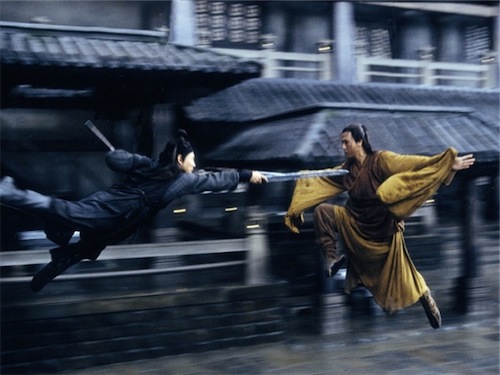
     When it comes to visual effects in films today, they are often an integral part of the film, which can often create a master piece or ruin a film in seconds. Hero, integrated both live fighting actions with post production adding all the special effects seen during the film. 

     Many hours must have been spent thinking about the ways in which to make the fight scenes different. It doesn't take you long to realize that the fight scenes couldn't ever happen in real life. I am not talking about the swordsmanship and martial art skills shown. What I am talking about is the ability to glide across water whilst fighting. Now that is something impressive if it ever were to happen and I am sure people would pay millions to see that. However, the style of fighting came across as a way of fighting in a magical time, where laws of gravity were not followed and that these particular assassins were a rare elite group of people capable of many magical things.


In the clip above, it shows the Kings amry about to fire thousands of arrow into a building where three of the Assassins are. Two decide to go out nd protect the people inside by deflecting the arrows away. The visual effects in this scene were amazing from the countless arrows flying in the air to how the assassins defend the building. I thought it was impressive how they used the red colour well throughout, from the paint to the clothes that they were wearing.

The scene below shows a clip of the "nameless" assassin fighting one of the other assassin. Only a few seconds in you are able to see thatmany creative element must have been used to perfect such a batle. I think they created a fighting scene that showed respect amongst both fighters and parties involved, which is not your average fight scene. I thought the man playing the music added to the magical side of it and was timed to match the fighting moves.


Overall, I am a big fan of thie film and would recomment it to many people. I was impressed with the quality of stars, martial arts choreographers, cinematographers, costume designers and musicians. They took a story based on fighting and an assassination attemp and make it abotu respect, loyalty, love and honor. 

p.s I also thought the fact that they didnt show much blood during the film, even though there were many deaths was a nice touch to it. 

Monday, February 3, 2014

silent films


Reflections on silent films

By Paul Dudson


In today’s movie making industry, a film has to make a big impact on its opening weekend otherwise it is deemed as unsuccessful. What do people expect to see though when they go to the movies? Great acting, great lines, special effects, heart stopping moments. The list could go on and on. I for one can appreciate watching an old classic where quite often these examples were not always in place. However, I was quite taken back by the silent films I was watching in class the other day. Charlie Chaplin in his silent movies to “man with a camera”, which was a documentary with no story line or actors. While sat in class watching these shorts clips being played to me, it didn’t take me too long to see how far we have come today with the technology we can create, but at the same time, I could appreciate for the time how interesting the stories were told and how much though had to go in to creating a story with no sound or famous actors as seen in the early days.


The reason there were no original movie stars in the first few years was because the camera quality wasn't the best and didn't have zoom, so many of the scenes being filmed were so far away that the abundance couldn't really see the persons face clearly enough. This all changed eventually as technology became more advanced and more directors became more creative, we were able to see more and more close ups of faces as seen in films such as "A trip to the moon" and "The cabinet of dr. Caligari". These are just two examples of many, but what we started to see was the range of close ups with different angles and lighting to create a more powerful message, especially in films either scary or without words.

One silent film is called "man with a movie camera", which was written and directed by Dziga Vertov. There were no story lines or actors throughout the whole documentary film. At first I was curious as to how this would keep me entertained for the whole time, but as the film went on, I could see that Dziga Vertov had used a variety of cinematography techniques, which I aims sure was cutting technology. I could see plenty of slow motion, jump cuts, split screen, shots played backwards etc. "The film has an unabashedly avant-garde style, and emphasizes that film can go anywhere". (http://en.wikipedia.org/wiki/Man_with_a_Movie_Camera)

What I liked about "Man with a movie camer" was that its aim wasnt to tell a story, but to show the audiance what a camera could do with a bit of post editing. To look at this now, we can see how many films today have copied and used the styles shown, making this film even more ground breaking and impotant to the production of film. I can see that Dreyer wasnt afraid to test and try new ways of filming whilst also showing scenes that might not have been proved approprite for the view - The woman giving birth scene. These are scenes that were aimed at showing the day to day lives and happinging in his country.


A film I enjoyed watching a silent film by Carl Theodor Dreyer's called "The passions of Joan of arc", which I felt stood out for its camera work of the facial areas and mass amounts of close up shots which were very short and sharp. The film was based around the trial of Joan of arc, which lead to her execution. It seemed that if there was ever a question aimed at Joan, it required a close up of everyone’s face to get their expressions as she answered their questions. As this film used sounds such as choir singing, it allowed the director to add certain types of the song to specific scenes during the film, which in turn brought more emphasis on the picture.

I Think something these films had going for them was that they were visually intreiging as they were all in black and white. This along with how objects were placed in the shots and the angles the camera was placed at to grab such experimental images. I think people are able to learn a lot from the old classic films. I for one find some of the effects they did very interesting.